Floridians React Snowing Up North Again
Slushy roads. Ice-topped power lines. Droopy branches sagging beneath the weight of accumulated snowfall. It sounds like something straight out of a New England winter. In fact, this was the scene right after New Year'south in Florida. And that shouldn't be, right?
The sea surrounds this so-chosen Sunshine Land on three sides. That h2o is as warm as a bathtub'south. This mild seawater heats the atmosphere all around it. The result? Florida simply doesn't get that common cold. It normally doesn't, anyhow.

That's why any snowfall in Florida is rare.
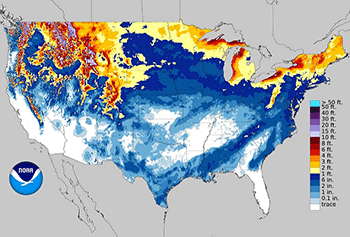
Just this U.Southward. wintertime is not typical.
By year-end, every U.S. state had recorded snow in 2017. Snow in Hawaii? Aye. Information technology has mountains whose high elevations poke into the common cold upper atmosphere. Texas? Yous bet. That was back on December 8. So what's been behind all of this recent wacky winter weather?
The jet stream is a river of air in the upper atmosphere. It races from regions of warmth to those that are cold. It'due south the atmosphere'due south way of balancing temperature differences. Sometimes, when this river of air snakes too far south, it tin can drag cold air with it. That's how a clamper of Chill air managed to sneak all the way down to the Gulf Coast.
In early December, the jet stream brought an uncommonly vigorous surge of cold air to the Deep Due south and northern Gulf of Mexico. In the starting time calendar week and a one-half of December, this blasted many usually warm states — ones that tourists typically abscond to in hopes of escaping common cold northern winters.
Corpus Christi is 1 of the southernmost cities in Texas. It saw snowfall for the first fourth dimension since Christmas 2004. This past Dec it picked up 2.54 centimeters (an inch) of the fluffy white stuff. That number doesn't tell the whole story, however. That total is what the "official" National Atmospheric condition Service observation station recorded. But that office is in boondocks. Just a few miles northwest, a full 12.7 centimeters (5 inches) of snow fell. If that had instead blanketed Corpus Christi, that boondocks would have set an all-time record!
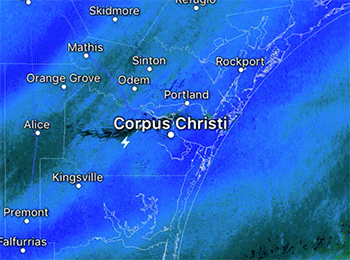
It'south challenging to see any lightning during a snowstorm. Just you tin detect when it'due south near past the muffled thunder that may rumble through dense clouds. This thundersnow occurred on the west side of Corpus Christi. That's where several heavy snowfall bands formed along the cold front. Three bolts of lightning fifty-fifty struck the ground!
December'south snow fabricated it all the style down to the Mexican border. It created a vista that many residents had never seen earlier. After all, you don't ordinarily see snow falling in the midst of palm copse. Ironically, Corpus Christi had by that time this wintertime picked up more than of the frozen white stuff than had so far hit the traditionally snowy cities of Boston, Chicago, Minneapolis, Detroit and Denver.
As this storm system raced due east, snowflakes continued to fly. They vicious on Arkansas, Louisiana, Mississippi, Alabama and Florida. Farther north in Georgia, the accumulation was more impressive. Many overachieving locations picked upwards xv.24 centimeters (half a foot). Most meteorologists chalked it upwardly to a freak outcome. Surely that wouldn't happen over again anytime soon, right?
Wrong!
Scientists Say: Weather bomb
Another band of heavy snowfall materialized near New Orleans, La., on January ii, 2018. It trekked into northern Florida. The National Weather Service office in that location, in Tallahassee, announced wintertime storm warnings for much of the surface area. This weather system carried snow and freezing rain all the way upwards the Atlantic coastline. In New England, it became a weather "flop." That means it intensified extremely quickly. Meteorologists described its boost in force equally "explosive."
Florida's dusting
The National Weather Service in Tallahassee shared a map showing several communities that picked up 0.64 centimeter (a quarter inch) of ice comprehend. A widespread dusting of snow to a couple centimeters blanketed much of the Florida panhandle and upper parts of the state'south peninsula. No snowfall barbarous farther south, where it was warmer. (Miami, for case, hasn't seen snow in nearly 41 years.)
Despite being rare, a Florida snowfall is not unheard of. Irene Sans is a meteorologist at WFTV News in Central Florida. She also serves on the board of the American Meteorological Guild. She had predicted Florida's recent snowfall, however still was amazed to see information technology.
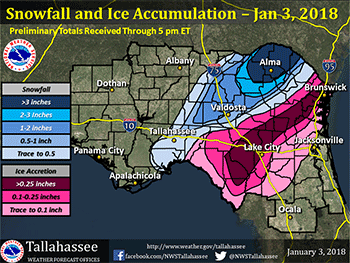
"It is rare, just it can happen," she says. "Tallahassee received simply a niggling. It wasn't much, just enough for many to remember for years. Luckily, this little snow quickly melts." She jokes that "many of us in Florida exercise not know how to bulldoze in the snow."
Maureen McCann works for the American Meteorological Society. She also is a television meteorologist and forecasts conditions in neighboring Orlando. She recalls that snow has fallen in local warm-weather condition zones a few times before. "Fundamental Floridians may remember when snow fell in January 1977." It accompanied a major outbreak of cold temps, she says. Snow didn't render once more until 2010, and that was at an particularly inconvenient time. "It occurred the weekend of the Disney Marathon. Runners who predictable doing the race in warmer weather were unpleasantly surprised."
What's more surprising about this winter's Florida snow, according to McCann, is how warm it's "supposed" to be in Orlando at this fourth dimension of year: 71º Fahrenheit (21.7º Celsius).
Farther north, Savannah, Ga., didn't quite pause its all-time record snowfall full this calendar month — but the region came shut. Information technology picked up three centimeters (over an inch). This storm as well brought something worse: freezing rain. It glazed roads, sidewalks, cars and even copse with ice. Winds to 113 kilometers per hour (70 miles per hour) blew moisture onto most surfaces. Information technology left the entire surface area a dangerous, if glistening, wonderland.

Savannah's previous snow record was set up 28 years agone. That December 1989 tempest dumped 9.1 centimeters (iii.half dozen inches). Jeremy Nelson is the chief meteorologist at WJCL 22 News, which serves littoral Georgia and S Carolina. He was blown away by the snowfall. He called it "a winter tempest that will exist remembered for decades."
"The biggest snow in 28 years hit Savannah on Wednesday, January 3," he explained. "The storm started with freezing rain earlier switching over to snowfall. Nigh areas picked up ii to three inches of snow. Even the beaches along the Atlantic Bounding main picked up an inch of snow!"
Charleston, South.C. also came close to setting a new record. Its top snow of 15.ii centimeters (six inches) brutal as part of that same 1989 storm. For now, that old record still stands.
A function for climate change?
Then why has the South seen so much frozen atmospheric precipitation lately? The answer may prevarication with global warming. Though information technology may seem surprising, the more Earth warms, the more rivers of frigid air may flow south toward the Gulf of Mexico.
Explainer: Weather and weather prediction
And the reason? The Arctic is warming significantly faster than the rest of the planet. That concept is widely accustomed by climatologists. It also appears dramatically in data being collected by NASA satellites and other weather condition-monitoring instruments used by the National Oceanic and Atmospheric Administration. As northern polar regions warm, the temperature dissimilarity between them and temperate zones — such equally the continental United states — diminishes. One result is that the jet stream slows downwards.
How could a slowing jet stream mean more cold air flowing south? Researchers accept recently establish some clues.
The jet stream's speed was non the major issue in the by few weeks' weather condition. The recent wacky events relate instead to the amplitude of the jet stream. That'southward a fancy give-and-take for its waviness.
Jennifer Francis is an atmospheric scientist at the Establish of Marine and Coastal Sciences. It's at Rutgers University in New Brunswick, N.J. She teamed up with Stephen Vavrus at the Eye for Climatic Research. That's at the University of Wisconsin in Madison. Together they were able to relate a slowing jet stream to a wavier jet stream. To practice this, they used archived weather maps. Then they tracked how wavy the jet stream was each 24-hour interval over a period of four decades.
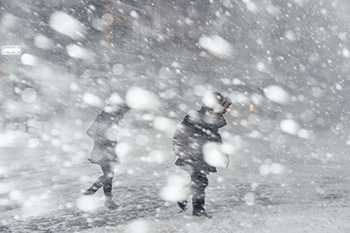
Equally the climate continues to warm, they argue, the jet stream volition just become wavier. When a jet stream slows, it will likewise tend to meander more. Then it gets wavy and wonky. And that means a normally northerly flowing stream of cold air might detour into the S, dumping unexpected frozen atmospheric precipitation along the way.
The frequency of so-called "high amplitude days" in the United states of america — when the jet stream is actress wavy — has spiked by more than 20 pct in the wintertime. That's compared to the average prior to 1979. Actually, the most dramatic fasten in wavy days has been showing upwardly in the fall, Francis and Vavrus reported a few years back. This is "when sea-ice loss and increased atmospheric water vapor augment Arctic warming."
When the jet stream gets wavy, it's easier for pockets of cold Canadian air to slosh southward. That cold air piles up in the troughs of jet stream waves. Therefore, a wavier pattern tin yield sporadic bursts of cold air, fifty-fifty in the Deep South.
As oceans warm, the amount of water vapor in the atmosphere will just rise. And that will feed more wet into these Arctic outbreaks that now can turn into snow.
Some people take claimed that the recent episodes of snow in weird locations disproves global warming. In fact, the contrary is true. These wacky weather patterns may be a seemingly strange symptom of climate change. Equally the world continues to warm, Francis warns, we're going to accept to expect the unexpected. Get ready, she says: "An increment in extreme weather events" is in store.
cunninghampoer1954.blogspot.com
Source: https://www.sciencenewsforstudents.org/article/wacky-winter-dumps-snow-every-single-us-state
0 Response to "Floridians React Snowing Up North Again"
Post a Comment